When intelligence becomes currency
Hey, it’s him again.
This afternoon he sat down to eat, chewing and thinking about AI at the same time. After a while he realized that no matter how smart the machines of the world become, he still has to eat. AI can write code, do math, read books, and research all night without getting tired. But he still has to grab a bowl of pho by six in the evening before he can sleep well. Maybe humanity’s future, after a very long loop, returns to two utterly basic things: electricity and food.
When intelligence is no longer scarce
For most of history, intelligence was a very expensive asset. To produce a good doctor, society had to raise a child, send it to school for more than twenty years, then let it work and accumulate experience for many more. The same was true for an engineer, lawyer, or researcher. Behind one hour of mental labor were decades spent forming a human being.
AI is gradually changing that structure. Intelligence is starting to be packaged as a service. Today we pay a few dozen dollars a month to chat with an AI. Tomorrow a company may hire thousands of agents to write software, support customers, research markets, analyze finance, or run work that once required an entire office full of people.
Then intelligence is no longer measured entirely by how many people we own. It starts to be measured by how much intelligence we can summon at any moment. A small company with ten people but an army of AI behind it can produce work that once required hundreds. A country that is not very populous but owns massive compute can generate more mental labor than its population size would suggest. Intelligence, in one sense, is gradually becoming a commodity. And when something that was once very scarce becomes abundant, value usually starts flowing toward what is needed to produce it.
Electricity begins to think
Behind an AI answer that feels invisible is a very physical world. There are chips, data centers, cooling systems, transformers, transmission lines running thousands of kilometers. And in the end, all of it needs electricity.
In the past, electricity lit homes, ran washing machines, powered factories, and pulled trains through cities. Now we are starting to use electricity for something entirely new: we use electricity to think.
An AI data center can be viewed as a factory that converts electrical energy into intelligence. Electricity goes in one end, and code, images, research, design, decisions, and millions of hours of mental labor come out the other. In the industrial age, countries with oil, coal, and factories held a huge advantage. In the AI age, energy matters just as much, except part of that energy no longer powers the muscles of the economy. It powers the brain.
So the AI race may not only be a race over who has the smartest model. A very smart model without enough electricity to run is like owning a city full of geniuses but having no rice for them to eat. The cheaper intelligence gets, the more valuable the electricity that feeds intelligence becomes.
And humans still have to eat
At the other end of civilization is something far more ordinary: food. AI can produce a million programmers inside data centers, but it still cannot produce a million hectares of fertile land. Software can be copied almost without limit, but a grain of rice still needs soil, water, sunlight, and time to grow. This is where the digital world hits the limits of the physical one.
For decades, people have been drawn to assets that can scale almost infinitely. Software can serve another million users at very little cost. An AI model can talk to millions of people at once. Knowledge can be copied with a click. But land cannot be copied, clean water cannot be downloaded, and a harvest cannot be accelerated by buying more GPUs. And eight billion people still have to eat every day.
If AI keeps reducing the scarcity of mental labor, people may start looking again at things long treated as too ordinary. Agricultural land, water sources, energy, food production, and distribution systems are not as flashy as a new AI model. But they sit closer to the base of the pyramid. Without AI, a society can still survive. Without food, every other story ends fairly quickly.
Two energy flows of civilization
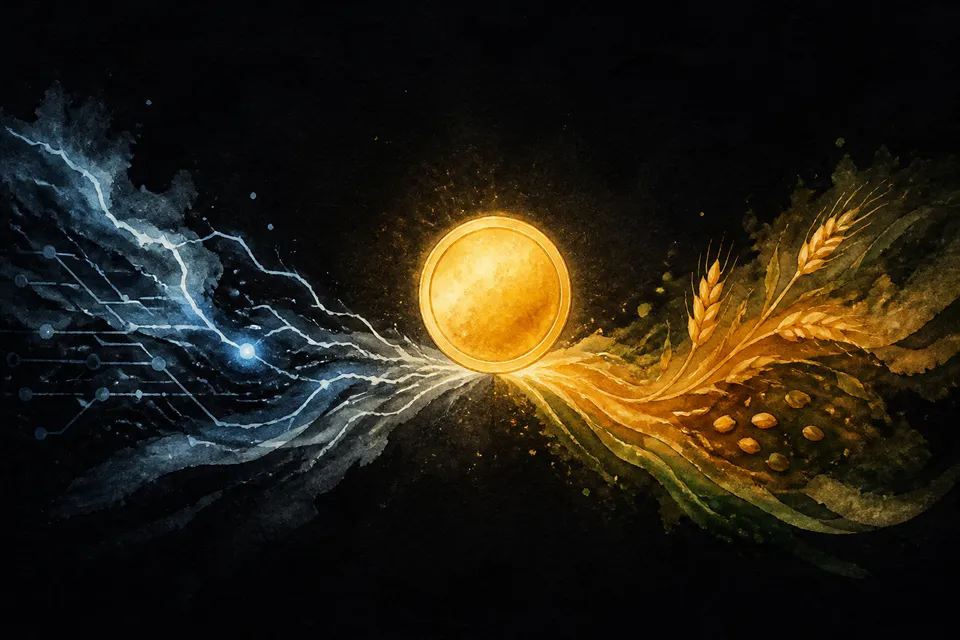
Seen that way, the future world may run on two energy flows. Electricity feeds intelligence. Food feeds humans.
On one side are solar farms, nuclear plants, hydro, gas, transmission grids, and massive data centers. Electricity flows through them, enters chips, and becomes intelligence. On the other side are soil, water, sunlight, crops, livestock, processing plants, and logistics networks. Solar energy passes through them, becomes food, and then becomes energy for humans. The two systems look very different, but in the end they are doing the same thing: feeding brains. One brain made of silicon, one made of flesh.
Between them sit money, assets, companies, stock markets, and thousands of financial layers humans built to distribute the right to use those resources. Perhaps because we have lived in the financial age for so long, we are used to measuring wealth in money. But money, at bottom, is only a promise that in the future we can exchange it for something. If one day there is a lot of money but not enough electricity, money cannot run a data center by itself. If there is a lot of money but not enough grain, money cannot turn itself into a bowl of rice.
The deeper he goes into the world of AI, the more he feels humanity is not really leaving the physical world as we once imagined. On the contrary, we are returning to it. After software comes the chip. After the chip comes electricity. After electricity come copper, uranium, gas, water, land, and transmission lines. After all those artificial brains are still billions of humans who need dinner.
Maybe a few decades from now, when intelligence has become cheap and everywhere like the internet today, the world’s most important assets will again be the things our ancestors fought over for thousands of years: energy, land, water, and food.
Only one thing will have changed. In the past, humans used electricity to run machines. Tomorrow, we use electricity to think.
❤️ cowriter aethery